I am Shi Haibin, styled Meon.
Born in Gaotang, north-west Shandong, in a jia-yin year, I have lived in Jinan for over thirty years.
Under the guidance of Mr Yu Maoyang, I hold to the principle that brush and ink must follow their age and strive to be of use.
Beginning with calligraphy and seal carving, I studied the East Asian ink tradition closely, then stepped beyond the bounds of painting and calligraphy to translate the aesthetic reflection of the traditional literati into an underlying method for brand culture.
One brush, two paths:
Explore below ↓
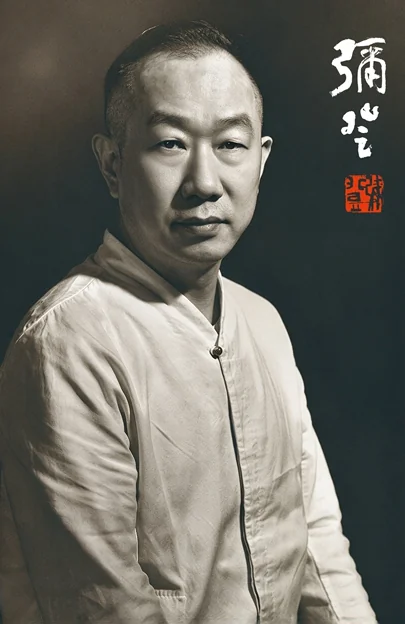
Biography
Shi Haibin, art name Meon, was born in Gaotang, north-west Shandong, and has lived in Jinan for more than thirty years. He is a leading designer in China, cross-disciplinary artist, Guochao (China-chic) calligrapher, seal carver, color ink painter and brand cultural designer. He abides by his mentor’s creed: “Brushwork shall advance with the times, and strive to create value and utility.” Rooted in calligraphy and seal carving, he delves into oriental brush art, breaking the boundary of pure painting and calligraphy, and translates the aesthetic thinking of traditional literati art into the underlying logic of brand culture.
As shared in interviews, oriental design is not a simple stack of decorative symbols, but the interpretation of inner spiritual temperament. Tradition does not equal retro, and modernity does not mean blind westernization. Quality brand design should be grounded in local culture, respond to the needs of the times, carry aesthetic quality and practical value, resonate with the market and audience.
For decades, he keeps two paths in parallel. He devotes himself to full-service brand design, helping local enterprises build cultural identity systems. Meanwhile, he engages in art education, exhibition judging and public cultural undertakings. Serving as off-campus master’s supervisor at Liaocheng University, he took part in judging activities and cultural exhibitions including “Kaiming Covenant · Five Artists Exhibition”, facilitating the integration of traditional calligraphy, seal carving, Guochao and modern design education.
His creation covers brand design, calligraphy, seal carving, color ink painting and photography. His design works have won multiple professional awards and been included in authoritative publications such as Asia-Pacific Design Yearbook. His calligraphy and seal works have been exhibited widely. He keeps exploring new ways for traditional brush art to speak in a contemporary context.
Source: six-language profile pages at 888ci.com (gj/jy/2016-12-15/144.html, /zh-tw/ /en/ /ja/ /ko/ /fr/); retrieved 2026-11-12
Two Lines of Practice
The Line of Design · Ganjiang Moye®
- Studio founded 1999 · company established 2005
- Full brand programmes / logo & VI / packaging & exhibitions
- Clients have included Siemens and Shandong Gold
- One of China’s 100 Outstanding Young Designers
The Line of Art · Meon
- Grounded in calligraphy, painting and seal carving; after fifty, pursuing poetry, calligraphy, painting and seals together
- Guochao calligraphy · colour ink · seal carving
- Created Meon® pearl-lustre colour ink
- Rooted in the Haotaiwang Stele (Gwanggaeto) · an epigraphic vigour
Teachers & Lineage
Yu Maoyang (calligraphy) · Gong Dechun (painting)
Teachers & Friends
Chronology
- 2024Entered social media, with 150,000+ followers across platforms; created Meon pearl-lustre colour ink
- EarlierCAPD “Kaiming Covenant · Five Artists Exhibition”
- 2011Pioneer of China’s design profession
- 2006One of China’s 100 Outstanding Young Designers
- 2005Founded Ganjiang Moye company
- 1999Founded Ganjiang Moye studio
- 1995Graduated from the Fine Arts Department, Liaocheng Teachers College
- ChildhoodBegan calligraphy, painting and seals under Gong Dechun and Yu Maoyang
Exhibitions · Publications · Honours
Exhibitions
- Kaiming Covenant · Five Artists Exhibition|Exhibitor
Publications
- Asia-Pacific Design Yearbook|Editorial board
- International Design Yearbook 2012|Editorial board
- China Design Yearbook|Editorial board
Honours
- 2006 One of China’s 100 Outstanding Young Designers
- 2011 Pioneer of China’s design profession
- China Star Best Design Award — 8 awards
- East China Grand Awards: 2 gold, 1 silver, 4 bronze
Appointments
Public and civic
- Member, China Association for Promoting Democracy
- Deputy director, CAPD Jinan Committee for Culture and the Arts
Education
- External master's supervisor, Liaocheng University
- Practice supervisor, Shandong University of Art & Design / Shandong University of Arts
Design profession
- National committee member, China Packaging Federation Design Committee
- Deputy secretary-general, provincial packaging design committee
- Juror, Qilu Star Awards
Arts institutions
- Director, Meon Art Museum
- Board member, Licheng District Photographers Association
Commercial & Guochao Practice
Words from My Teacher
- “The culture of calligraphy rests upon the honing of craft.”
- “There is no trick to being a person — only sincerity, truthfulness, kindness and love. I love calligraphy; every single stroke I write reflects the principles and the feeling by which I try to live.”
- Mr Yu Maoyang pioneered professional calligraphy education in China's modern universities. He stepped outside the conventional model that equates calligraphy with making works on paper. His programme rests on three commitments: restoring the practical uses of calligraphy, connecting it with modern design, and forming versatile graduates able to put their training to work.
- A pioneer of modern university calligraphy education in China, Mr Yu Maoyang established the first teacher-training programme in calligraphy and the first concentration in decorative calligraphic art. He held that reverence for the past should not mean neglect of the present, attending both to the aesthetic value of calligraphy and to its contemporary uses. His teaching followed the principle of “one specialism, many skills; learn in order to apply”: on a firm grounding in traditional brush and ink, he dissolved the boundaries between calligraphy, craft and design, guided calligraphy into modern life, and formed artists with both cultural depth and practical ability.
- First acquire a craft by which to live; then pursue artistic development. The first two years build a foundation in stele models and brush-and-ink, the last two branch into studios of material, craft and design. A graduation piece need not be a hanging scroll on xuan paper: it may be ceramic carving, woodcut, installation or spatial calligraphy. Calligraphy thus leaves the two narrow tracks of “calligrapher” and “calligraphy teacher” and extends into brand identity, cultural products, public art and wayfinding.
- Calligraphy began as everyday writing, both beautiful and useful, and should not retreat into a niche craft for gallery connoisseurs. He held that “brush and ink must follow their age”, adapting of their own accord to new materials, new spaces and new media. He also held that calligraphy knows no mainstream or marginal: any beauty recognised by the public deserves respect. At the same time he insisted that technical grounding is the foundation and cultural literacy the structure above it — neither may be neglected.
- Honour the past without slighting the present. Calligraphy has no mainstream and no margin: whatever the public holds to be beautiful, the invention of every kind of writer deserves affirmation.
Translated from the Chinese original; no facts added.
Artist Statement
I am Shi Haibin, styled Meon. Born in Gaotang, north-west Shandong, in a jia-yin year, I have lived in Jinan for over thirty years. Under the guidance of Mr. Yu Maoyang, I hold to the principle that brush and ink must follow their age and strive to be of use. Beginning with calligraphy and seal carving, I have studied the East Asian ink tradition closely, then stepped beyond the bounds of painting and calligraphy to translate the aesthetic reflection of the traditional literati into an underlying method for brand culture. One brush, two paths: design and art.